

Sachida Nand
217 rep
Pilot This is a citizen-led research thread. Contributions and reputation are AI-assisted pilot estimates — verify claims against the original source before acting on them.
BallotBoxIndia treats a district's development like a shared fund, and every socio-political innovator — leader, NGO, business, expert, journalist, activist — like a contributor whose impact we try to measure. The scores here are an experiment to tell apart what an innovator actually moved (नेता का हाथ · their real contribution) from what circumstance carried (हालात · the wave).
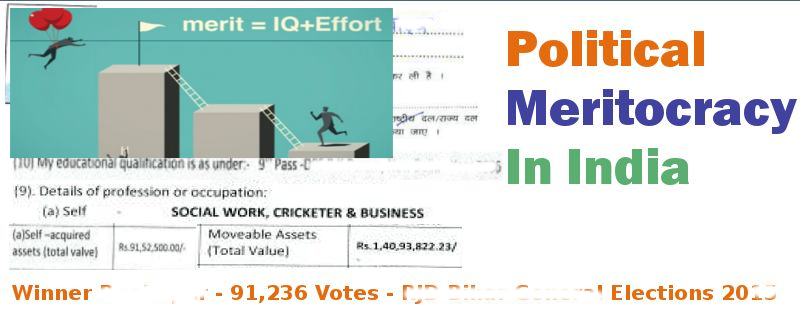
 A professional cog in the wheel job requires at least 16 years of formal education, along with multitude of continuous evaluations all those years. After all these evaluations, with a history of consistent performances; At each and every stage of professional ladder, we are judged by bare-knuckle performance, And we are in a need to keep evolving and prove efficacy to the bottom-line.
A public service professional goes through standardized UPSC or state Selection commission processes and undergo rigorous training to make them ready for an IAS, IRS, IPS, IFS or other specialized jobs.
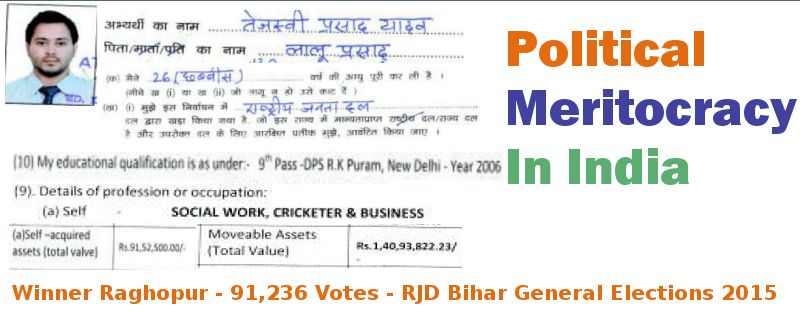
But the public representatives of India (read MLAs, MPs, ruling, opposition, standby, Legislatures, political party officials et. al) who are in charge of defining the whole semantics, in which every other species under the jurisdiction's influence, live and prosper, are left to the forces of an inefficient market to define their competence and suitability to the job.
Voters without any standardized mechanism are influenced by high pitched anecdotes, myths, and folklore. The whole circus of elections in India is about how many sandstorms can be raised to lead voters to their camps every 5 years. It's entertaining at some points but largely sad watching public wastage of money, and reasonable people waiting with their hands folded wearing garlands with drums and bikes doing weird stuff to supposedly woo voters.
The point is, are there specialized quantifiable evaluation parameters available or can be evolved, so a voter can make a decision swiftly on who is worthy to represent them, evaluate them continuously on solid data based performance framework.
We believe for anybody to start their career in policy making space, they should be advanced level experts in
1. Economics, Political & Social Science, Philosophy.
2. Indian and world history and evolution.
3. Existing laws, constitution and their evolution.
4. Significant experience in public or professional organization space.
5. Expert in at least one elective field of his own personal or professional interest, be it mathematics, core science, literature, marine science, Arts, Performing Arts, sports with recognition.
Points 1-4 are required for proper understanding and disposal of any policy decision and #5 builds character.
Politician's prime job is to reconcile conflicting interests, be able to reach across partisan lines to evolve a consensus. Work expertly on policy making and be the reliable bridge between public perception and legislation.
It's a job involving a higher level of managerial as well as organizational skills, along with deep understanding, interest, and passion towards the subject; compassion to general public and respect for their colleagues in political fraternity. It can only be inculcated in the case when the candidate goes through a transparent and meritocratic process and trained effectively to do the job with utmost professional respect and justice it deserves.
The benefits of this process are far reaching as discussed below,
- Will take out all the drama and wastage associated with elections, since the candidate will only be of serious, opinionated and professional having a standardized background to baseline.
- High level of competition and expertise with certain behavioral benchmarks related to training and profession.
- A ready pool of experts with experience and inclination to choose into panels and ministerial positions.
- Weed out non-serious candidates like dynastic, musclemen and dummies looking at party whip without contributing to the process.
- Ease to recall the election in case post-election evaluation fails, As runner-ups are being from the same standard of a quantifiable process can take the place.
Finally, considering the deep root current process has taken, along with possible interests of few of the current batch of representatives in status quo, it might look difficult, but worth a try, considering the stakes are so high.
What we think would work is
1. People looking for political leadership roles should complete the curriculum, via a credit system of study from designated central universities. There shouldn't be any entrance exam but an evaluation and examination system ranging at least 3 years.
2. After education, the candidates should work in their chosen constituencies at grass root level experiment and enhance existing system to come up with success stories. Either independently or with political parties of their liking.
3. The work done is fully documented with proper impact analysis.
4. Only candidates from this pool are allowed to fight the election.
5. Every political party should have a roaster of candidates ready to take up respective ministries, and their resume's and achievements wholly and continually documented in public view.
6. Independent Rating Agencies similar to the financial instrument equivalent S&P, Moody's, Fitch etc and Government's own, need to continually evaluate these candidate's performances against a set parameter and declared in open to the public.
The result will be High-quality candidates coming out of these meritocratic systems, fighting the ultra-competitive elections, Hence we get the candidate with highest IQ and EQ(Emotional Quotient) leading us forward, instead of just people with superior social skills as its happening right now.
This can be seen in conjugation with the election reforms campaign - Janmela
People moving this research forward. Reputation accrues to whoever moves each milestone.





BallotBoxIndia is an AI-assisted pilot. Content here is reviewed by an editorial process against open, public journalistic standards and checked by human editors before it is featured. Every page is assessed for:
Figures and generated text are pilot estimates and may contain errors. If something here is wrong or unfair, we honour corrections and right of reply — contact editors@ballotboxindia.com.
Join as a member or expert, add a milestone, and be credited for the work. No money changes hands — the currency is your effort and analysis.
Join this research →